









Abstract
In arid regions of the Global South, particularly the Gulf Cooperation Council (GCC) states, adopting agricultural technologies is vital for maximizing productivity and achieving sustainability. Despite their demonstrated benefits, adoption rates among small-scale farmers remain low due to water scarcity, environmental degradation, and socio-cultural and institutional barriers. This study explores the factors that influence farmers’ perceptions and decisions to adopt agricultural technologies, in small-scale urban farms in the pre-urban areas., providing valuable insights for enhancing adoption in these challenging environments. By utilizing the Unified Theory of Acceptance and Use of Technology (UTAUT) framework, along with diffusion of innovation, institutional and risk theories, data was gathered through a structured questionnaire and analyzed using ordinal logistic regression (OLR). The analysis identified key drivers of adoption, including performance expectancy, effort expectancy, social influence, facilitating conditions, trust in government and technology providers, and cultural norms. Perceived risk negatively influenced adoption, while compatibility was not statistically significant. The findings highlight the importance of creating supportive environments through transparent communication, infrastructure development, and tailored assistance. Recommendations focus on leveraging social networks, fostering trust, mitigating risks, and aligning technologies with cultural practices to scale up sustainable technology dissemination. This study offers valuable insights for policymakers and practitioners aiming to promote agricultural technology adoption in arid environments, contributing to sustainable development discourse in the Global South.
Introduction
Urban agriculture has emerged as a vital strategy for enhancing food security, promoting sustainability, and addressing the growing demand for local food production in arid regions. In the Gulf Cooperation Council (GCC) states, the Urban agriculture concept adopted in the present research centered around the small-scale urban farms around city skirts. These farming activities within and around cities, provides many social, economic, and environmental benefits. [1]). In the region where water scarcity, harsh climatic conditions, and limited arable land pose significant challenges, adopting advanced agricultural technologies is critical to overcoming these barriers. Innovations such as hydroponics, vertical farming, and climate-smart practices offer promising solutions to increase productivity while conserving resources. However, despite these technological advancements, adoption rates among small-scale and urban farmers remain low due to socio-cultural norms, institutional constraints, and perceptions of risk. Understanding the drivers behind technology adoption in urban agriculture is essential to creating targeted strategies that align with local needs and sustainable development goals. Technologies such as drip irrigation, drought-resistant crop varieties, soil moisture sensors, and precision farming tools are critical in these settings [2]. They are not only helpful in maximizing yields with minimal resource inputs; they also contribute to the long-term sustainability of agricultural practices by conserving water, reducing dependency on chemical fertilizers, and minimizing soil degradation.
Understanding the factors that influence the adoption of these technologies is essential for policymakers, researchers, and practitioners aiming to promote sustainable agricultural practices in arid regions. Several factors influence the adoption of agricultural technologies in arid environments [3,4,5]. These studies have highlighted key adoption barriers, such as institutional constraints and socio-cultural factors, but has often lacked an integrated theoretical approach or region-specific analysis. By incorporating UTAUT, our study offers a more comprehensive framework to examine adoption dynamics in the GCC context. Yet some other studies discussed factors ranging from socio-economic conditions to institutional support and individual farmer characteristics and perceptions. Economic factors, including the cost of technology, access to credit, and the potential for increased profitability, play a significant role in the decision-making process. Social factors, such as education level, access to information, and community networks, also impact farmers’ willingness and ability to adopt new technologies[6]. Institutional support through government policies, extension services, and agricultural training programs can facilitate or hinder adoption rates. Additionally, environmental factors, including the severity of arid conditions and the availability of natural resources, directly affect the perceived necessity and effectiveness of adopting specific technologies [7]. Understanding these multifaceted influences requires a comprehensive approach considering the interplay between economic, social, institutional, and environmental dimensions [8].
This study examines the factors influencing the adoption of agricultural technologies in the GCC’s urban agriculture sector. The adoption of agricultural technologies in the GCC states is crucial due to the region’s extreme aridity, water scarcity, and rapid urban expansion, which limit traditional farming. Despite government support and initiatives to enhance local food production and reduce import dependence, adoption rates remain low due to socio-cultural and institutional barriers. Small-scale urban and peri-urban farms play a key role in food security, making it essential to understand factors influencing technology uptake. Trust in institutions, cultural perceptions, and risk concerns shape adoption behaviors, highlighting the need for policies that align with local values, improve infrastructure, and provide targeted support for sustainable agriculture in arid environments. The study primarily focuses on low- to medium-complexity technologies commonly adopted in small-scale urban farms across the GCC, such as drip irrigation systems, drought-resistant crop varieties, soil moisture sensors, and organic soil amendments. While more advanced solutions like climate-smart digital farming and vertical farming are acknowledged, they fall outside the primary scope due to their higher capital and technical requirements, which are less accessible to the target population. The study is guided by the Unified Theory of Acceptance and Use of Technology (UTAUT) framework and supplemented by diffusion of innovation, institutional, and risk theories, the research investigates key variables such as performance expectancy, cultural norms, perceived risks, and trust in government and technology providers. By identifying the drivers and barriers to adoption, this study aims to provide actionable insights for policymakers and practitioners seeking to promote sustainable urban agriculture practices. The findings are expected to contribute to the broader discourse on food security, resource management, and resilience-building in the Global South’s challenging environmental contexts.
Despite these advancements, the rate of technology adoption remains uneven across different regions and among various farmer demographics, highlighting the need for a deeper understanding of the underlying factors influencing adoption decisions [9]. Several studies have explored the socio-economic and institutional factors affecting the adoption of agricultural technologies in arid environments. Feder et al. [10] provided an early framework for understanding technology adoption, emphasizing the importance of economic incentives, access to credit, and risk perceptions. Recent studies have expanded on this framework, incorporating social and institutional dimensions. For instance, Rogers [11] highlighted the role of information dissemination and social networks in facilitating technology adoption. In the context of the GCC states, research by Al-Marshudi [12] and Al-Ghobari & Dewidar [13] pointed out that limited access to financial resources and inadequate extension services are significant barriers to adoption among small-scale farmers. Additionally, studies have shown that participatory approaches, such as farmer field schools and demonstration trials, can enhance farmers’ knowledge and confidence in using new technologies[14,15,16]. [17] These insights emphasize the multifaceted nature of technology adoption and the necessity of integrated policy approaches that address economic, social, and institutional barriers to promote sustainable agricultural practices in the GCC states. The adoption of agricultural technologies in this arid environment is critical due to the region’s extreme climatic conditions and scarce water resources.
Research findings indicated that innovative agricultural technologies such as drip irrigation, drought-resistant crop varieties, and precision farming tools have been instrumental in mitigating the adverse effects of water scarcity and poor soil conditions prevalent in arid regions. For instance, research conducted by Burney et al. [18] and Fereres & Connor [[19], [20]] has shown that drip irrigation systems may greatly enhance both water usage efficiency and agricultural production when compared to conventional irrigation techniques. Similarly, drought-resistant crop varieties have been documented to enhance resilience to climatic stressors, thereby stabilizing food production in unpredictable weather conditions [21,22].
The GCC states, including Saudi Arabia, the United Arab Emirates, Qatar, Kuwait, Oman, and Bahrain, face unique agricultural challenges that necessitate innovative solutions. The literature outlined the importance of advanced irrigation techniques [23],Ouda, 2004), soil management practices, and the introduction of drought-resistant crop varieties to mitigate the harsh conditions. For example, Al-Rumikhani [24] discusses the application of treated wastewater in agriculture as a sustainable practice in Saudi Arabia, emphasizing the need for alternative water sources to support agricultural activities. Additionally, research by Shahbaz et al. [25] highlights the benefits of using hydrogel and organic amendments to improve soil water retention and crop yield in arid regions. In the GCC states, farmers education levels, significantly influence technology adoption. A study by Shikur et al. [26] examines the barriers to adopting precision agriculture technologies in the UAE, noting that high costs and limited technical expertise are major obstacles. Furthermore, institutional factors such as government policies, extension services, and financial incentives play a crucial role in facilitating or hindering the adoption process. According to Al-Karablieh et al. [27], effective policy measures and robust agricultural extension services are essential to enhance technology adoption among farmers in arid regions. Collaborative efforts involving government agencies, research institutions, and the private sector are vital for promoting sustainable agricultural practices and addressing the unique challenges faced by farmers in the GCC states [[28], [29]].
Conceptual model and hypotheses development
To explore the factors influencing the adoption of agricultural technologies to enhance production and sustainability in GCC states, this study employs an integrated theoretical framework anchored in the Unified Theory of Acceptance and Use of Technology (UTAUT) developed by Venkatesh et al. [30]. The UTAUT framework was chosen for its robust and comprehensive structure, which systematically examines both the technological determinants and behavioral attitudes driving technology adoption. Its adaptability further allows for the incorporation of additional constructs tailored to the unique socio-cultural, institutional, and environmental contexts of agricultural practices in the GCC region.
The selection of UTAUT over other established technology acceptance models, such as the Technology Acceptance Model (TAM) by Davis [31], is grounded in its broader explanatory power and empirical robustness. While TAM has contributed significantly to understanding individual-level technology acceptance through its focus on perceived usefulness and perceived ease of use, it does not sufficiently account for the social, organizational, and contextual factors that influence adoption behaviors in more complex environments [32,33]. UTAUT addresses this limitation by incorporating four core constructs—performance expectancy, effort expectancy, social influence, and facilitating conditions—as well as key moderating variables such as age, gender, and experience. This expanded scope allows for a more comprehensive assessment of technology adoption, particularly in agriculture, where decisions are shaped not only by perceived utility but also by institutional support, cultural norms, and access to infrastructure.
The UTAUT model has been extensively validated and contextualized across diverse technology acceptance domains, including healthcare[34], banking[35], education[36,37], transport technology [38], and risk management[39]. It has also demonstrated significant applicability in agricultural settings. For instance, Ronaghi and Forouhar [40] utilized UTAUT to identify technological factors affecting farmers’ intentions to adopt Internet of Things (IoT) technology in the Middle East. Cimino et al. [41] applied the model to examine small farmers’ behavioral intentions to adopt a pioneering digital platform aimed at fostering sustainable agricultural ecosystems. Similarly, Faridi et al. [42] combined UTAUT with the Initial Trust Model (ITM) to evaluate the effectiveness of water and soil conservation measures among paddy farmers in Rasht County. Mittal and Mehar [43] employed a multivariate probit model grounded in UTAUT to analyze how socio-economic factors influenced farmers’ adoption of modern information and communication technologies for decision-making. Furthermore, Nguyen et al. [44] applied UTAUT to investigate the behavioral intention of smallholder rice farmers to adopt precision agriculture technology.
Despite its strengths, the UTAUT model alone may not fully capture the complex interplay of factors influencing agricultural technology adoption in the GCC, where farmers face unique challenges such as water scarcity, traditional farming practices, and reliance on institutional support. To address these complexities, this study extends the UTAUT model by integrating constructs from complementary theories:
- 1.Diffusion of Innovation (DOI) [11]: DOI emphasizes the role of compatibility—the alignment of new technologies with existing practices and values—in facilitating adoption.
- 2.Risk Theory [45]: This theory highlights the influence of perceived risks, including financial and environmental uncertainties, on decision-making processes.
- 3.Institutional Theory [46,47]: Institutional theory sheds light on the importance of trust in government agencies and technology providers, which is critical in environments where institutional support plays a significant role in driving adoption.
By integrating these theoretical perspectives, the study develops a comprehensive framework that captures the multi-faceted factors shaping farmers’ intentions and behaviors. This approach not only builds on the strengths of the UTAUT framework but also incorporates essential socio-cultural and environmental dynamics, offering a nuanced understanding of agricultural technology adoption in the GCC. The insights derived from this integrated framework aim to inform targeted interventions and policy strategies, ultimately advancing agricultural productivity and sustainability in arid regions.
In this study, the dependent variable—farmers’ intention to adopt agricultural technologies—is conceptualized as a multidimensional construct comprising four key dimensions: perceived benefits, adoption readiness, support utilization, and long-term farm viability. These dimensions reflect farmers’ productivity expectations, preparedness for adoption, willingness to engage with institutional support, and perceptions of long-term sustainability. This structure provides a holistic foundation for assessing behavioral intention within the agricultural context.
Perceived benefits refer to farmers’ belief that adopting agricultural technologies will improve their farm productivity, efficiency, and overall performance. This dimension captures the anticipated positive outcomes associated with technology adoption, such as increased crop yields, improved resource utilization, and enhanced farm profitability. Adoption readiness refers to the extent to which individuals or groups are prepared to integrate agricultural technologies into their operations [48]. This concept encompasses three interrelated dimensions: psychological readiness involves the attitudes, beliefs, and perceptions of farmers regarding the usefulness, ease of use, and potential benefits of new technologies; behavioral readiness pertains to prior actions, habits, and willingness to engage in change, including past experiences with technology use, openness to learning new systems, and motivation to alter existing farming practices; and contextual readiness reflects external conditions that support or hinder adoption, such as access to infrastructure (e.g., internet connectivity), institutional support (e.g., extension services), market conditions, and policy environments.
Support utilization reflects farmers’ willingness and intention to engage with available institutional support systems when adopting agricultural technologies. This includes utilizing training programs, extension services, financial aid, and technical assistance offered by government agencies, cooperatives, or private organizations to facilitate successful technology adoption. Long-term farm viability refers to farmers’ intention to adopt technologies based on their belief that such innovations will contribute to the sustained productivity, profitability, and resilience of their farm operations over time. This includes considerations of resource efficiency, environmental sustainability, and economic security, which are essential for long-term agricultural viability in evolving agricultural systems[49].
Hypotheses derived from the UTAUT framework
Performance expectancy (PE)
Performance expectancy is identified as a crucial factor in shaping behavioral intention within the UTAUT model. According to Venkatesh et al. [30], PE reflects individuals’ beliefs and perceptions regarding the potential benefits of utilizing new innovative technologies in the workplace, influenced by factors such as extrinsic motivation, job fit, relative advantage, and outcome expectations. In an agricultural setting, several research articles have demonstrated that performance expectancy positively influences farmers’ behavioral intention to adopt agricultural technologies[41,40]. Based on this rationale, we propose the following hypothesis:
H1: Performance expectancy positively influences farmers’ intention to adopt agricultural technologies that enhance productivity and sustainability in the GCC States.
Effort expectancy (EE)
Effort expectancy is conceptualized within the UTAUT model framework to represent individuals’ perceptions and experiences regarding the ease of adopting and utilizing new technologies or information systems. Venkatesh et al. [30] define effort expectancy as “the degree of ease associated with the use of the system.” Previous literature in the agricultural context has consistently shown a significant direct relationship between effort expectancy and individuals’ attitudes toward adopting agricultural technologies[50,42,51,52]. According to this discussion, the following hypothesis was also formulated:
H2: Effort expectancy positively influences farmers’ intention to adopt agricultural technologies that enhance productivity and sustainability in the GCC States.
Social influence (SI)
According to the initial definition by Venkatesh et al. [30], the construct “Social Influence” reflects individuals’ perceptions of the beliefs and expectations held by other influential people regarding the adoption of specific technologies. Existing literature in agricultural settings consistently demonstrates a positive influence of perceived Social Influence on individuals’ intention to utilize new technologies[50,43,44]. According to this discussion, the study puts forward the following hypothesis:
H3: Social influence positively influences farmers’ intention to adopt agricultural technologies that enhance productivity and sustainability in the GCC States.
Facilitating conditions (FC)
In the UTAUT model, Venkatesh et al. [30] conceptualize the facilitating conditions factor to reflect the degree to which an individual perceives that organizational and technical infrastructure is in place to support and sustain the use of new technologies. In an agricultural setting, it has been shown that facilitating conditions directly influence farmers’ decisions to adopt new innovative technologies (Ronaghi & Forouharfar, 2020; [53]. This discussion leads us to propose the following hypothesis:
H4: Facilitating conditions positively influence farmers’ intentions to adopt agricultural technologies that enhance productivity and sustainability in GCC States.
Hypotheses derived from complementary theories
Perceived risk (PR)
Perceived risk refers to the uncertainty farmers feel about whether new technologies will deliver promised benefits, be compatible with their farming conditions, or require skills they lack. While initial cost is a component, the greater concern is often the risk of failure due to underperformance or poor installation, lack of technical support, or soil salinity issues, which are common in the GCC. Perceived risk of adopting new technologies can deter adoption[45,42]. Based on this discussion, the study proposes the following hypothesis:
H5: Perceived risk negatively influences farmers’ intention to adopt agricultural technologies that enhance productivity and sustainability in the GCC States.
Compatibility (CO)
Compatibility reflects the degree to which a technology aligns with farmers’ existing practices, values, and experiences. Technologies perceived as compatible are more likely to be adopted[41,11]. Accordingly, the following hypothesis is proposed:
H6: Compatibility positively influences farmers’ intention to adopt agricultural technologies that enhance productivity and sustainability in the GCC States.
Trust in government/technology providers (TR)
Trust in government or technology providers refers to the confidence farmers have in the reliability and effectiveness of those promoting the technology. High trust increases the likelihood of adoption[46,42]. Consequently, the following hypothesis is formulated:
H7: Trust in government/technology providers positively influences farmers’ intentions to adopt agricultural technologies that enhance productivity and sustainability in the GCC States.
Cultural norms (CN)
Cultural norms capture the influence of societal and cultural beliefs on technology adoption. Deeply rooted traditions can either encourage or hinder the uptake of innovations [46,43]. In the GCC region, cultural norms influencing technology adoption may include preferences for traditional farming methods passed down through generations, scepticism toward unfamiliar practices, and the high value placed on personal relationships and community approval. For example, farmers may be hesitant to adopt digital or automated technologies if they perceive them as undermining traditional labour roles or if these innovations lack endorsement from respected community members or tribal leaders. Based on the preceding discussion, the following hypothesis is formulated:
H8: Cultural norms significantly influence farmers’ intention to adopt agricultural technologies that enhance productivity and sustainability in the GCC States.
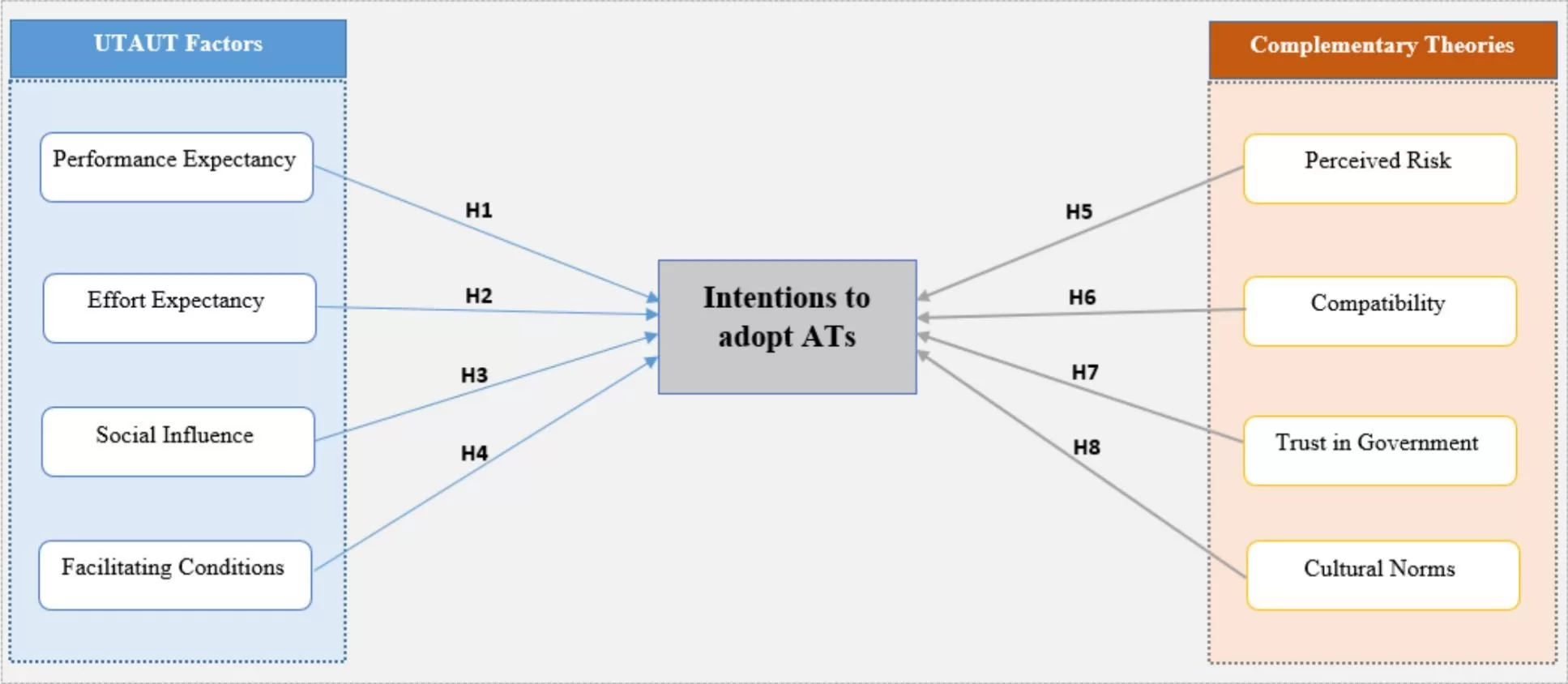
Fig. 1 illustrates the conceptual model that outlines the key predictors of farmers’ intentions to adopt agricultural technologies. The model presents eight hypotheses, capturing both technological and contextual factors that influence adoption behavior.
Leave feedback about this