



Abstract
Small-scale fisheries and aquaculture play a crucial role in securing food, income, and nutrition for millions, especially in the Global South. Rural small-scale aquaculture (SSA) is characterized by limited investment and technical training among farmers, diversification and dispersion of farms over large areas, reduced access to competitive markets for inputs and products, and family labor. Small-scale integrated circular aquaponic (ICAq) systems, in which systems’ component outputs are transformed into component inputs, have significant potential to increase circularity and promote economic development, especially in a rural context. We offer an integrated and comprehensive approach centered on aquaponics or aquaponic farming for small-scale aquaculture units. It aims to identify and describe a series of circular processes and causal links that can be implemented based on deep study in SSA and ICAq. Circular processes to treat by-products in ICAq include components like composting, vermicomposting, aerobic and anaerobic digestion, silage, and insect production. These processes can produce ICAq inputs such as seedling substrates, plant fertilizers, bioenergy, or feed ingredients. In addition, the plant component can supply therapeutic compounds. Further research on characterization of aquaponic components outputs and its quantifications, the impact of using circular inputs generated within the ICAq, and the technical feasibility and economic viability of circular processes in the context of SSA is needed.
Keywords:
agri-aquaculture systems; circular food production; circular economy; aquaponics waste management
1. Introduction
By 2032, aquatic animal production from aquaculture is expected to increase by 17.4% compared to 2022, primarily through intensified and expanded sustainable aquaculture practices [1]. It is also projected that in 2032, aquaculture will supply 60% of global fish food consumption [1]. Aquaculture externalities can be either negative or positive, and the way aquaculture develops could positively influence human well-being and environmental health outcomes, especially in regions where economic policies focus on social equity and environmental sustainability [2]. Primary negative environmental impacts come from fed aquaculture (specifically pollution and global warming) and water access and usage; thus, promoting recycling systems that reduce water consumption and promote nutrient recovery and reuse is essential [3].
Currently, 95% of aquaculture production occurs in developing countries in the so-called Global South, with 70–80% of individuals involved in aquaculture being small-scale, defined by FAO as “aquaculture that use relatively small production units with relatively low input and low output, and limited levels of technology and small capital investment” [4,5]. Globally, the fisheries and aquaculture sector provides jobs and secures livelihoods for approximately 61.8 million people [1]. This primarily occurs in Global South countries, specifically within small-scale fisheries (SSFs) and small-scale aquaculture (SSA) [1,6,7]. SSA has the potential to contribute to sustainable rural development through various means such as ensuring food security, fostering wealth generation, diversifying livelihoods, generating employment opportunities, and leveraging family labor, among other benefits [6,8]. Rural SSA systems involve farms that own or have access to aquatic resources, typically with limited investment in assets and operational costs. These farms may operate with family or community ownership and labor, and they may or may not be the main source of livelihood [6]. Integrated systems that include the SSA often combine the use of terrestrial manure or sewage as fertilizer for fishponds, along with fertigation for culture fields and fruit trees [6,9]. These systems typically operate with informal management structures and often have limited access to technical resources, expertise, formal education, and information—including market information—which can be reflected in the low sales values achieved on farms, local markets, or through intermediaries [6,9,10].
Farming diversification through the integration of diverse resource-sharing farming is a characteristic of small-scale aquaculture farming in rural and peri-urban areas, especially benefiting impoverished communities [11]. Integrated aquaculture–agriculture value chain activities are appropriate for resource-poor households [12]. Furthermore, according to FAO [3], circular and sustainable food systems that promote sustainable management and use of resources are required to ensure the sustainable development of aquaculture. In this context, aquaponic farming is a production technique that integrates aquaculture with plant cultivation, utilizing the aquaculture water as a nutrient solution. This technique encompasses two plant culture methods: hydroponics (aquaponics), where plants draw nutrients directly from aquaculture-derived water, and non-hydroponics (trans-aquaponics), which employs a combination of soil and nutrient-rich aquaculture water [13]. Aquaponic farming diversifies production systems and represents a pathway toward a more sustainable production system by recycling resources such as water and nutrients.
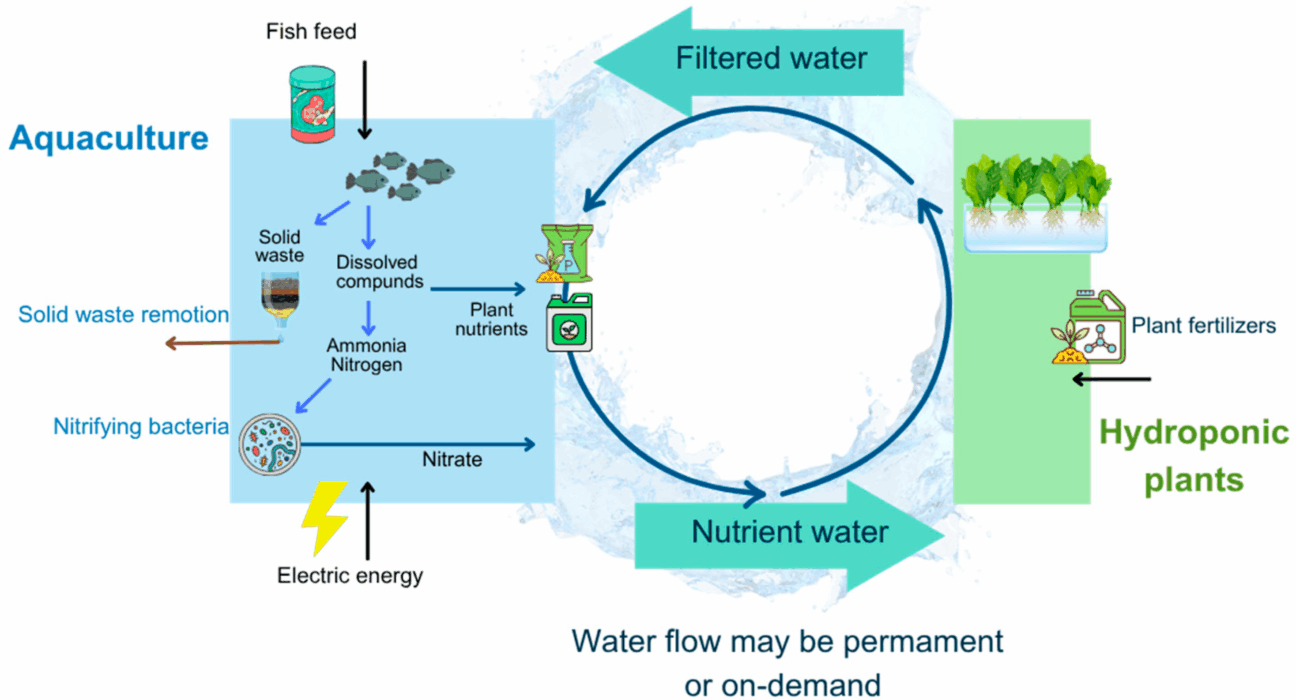
In recent years, aquaponics (Figure 1), a technology that couples tank-based animal aquaculture with hydroponics involving microbiological processes—using water from aquaculture for plant nutrition and irrigation [13]—has attracted the attention of researchers and entrepreneurs worldwide, as it is considered a sustainable system that can potentially improve food security in developed and developing countries in the face of drought, soil fertility loss, climate change, and urban growth [1,14,15].
https://www.mdpi.com/2079-9276/14/8/119?utm_source=chatgpt.com