



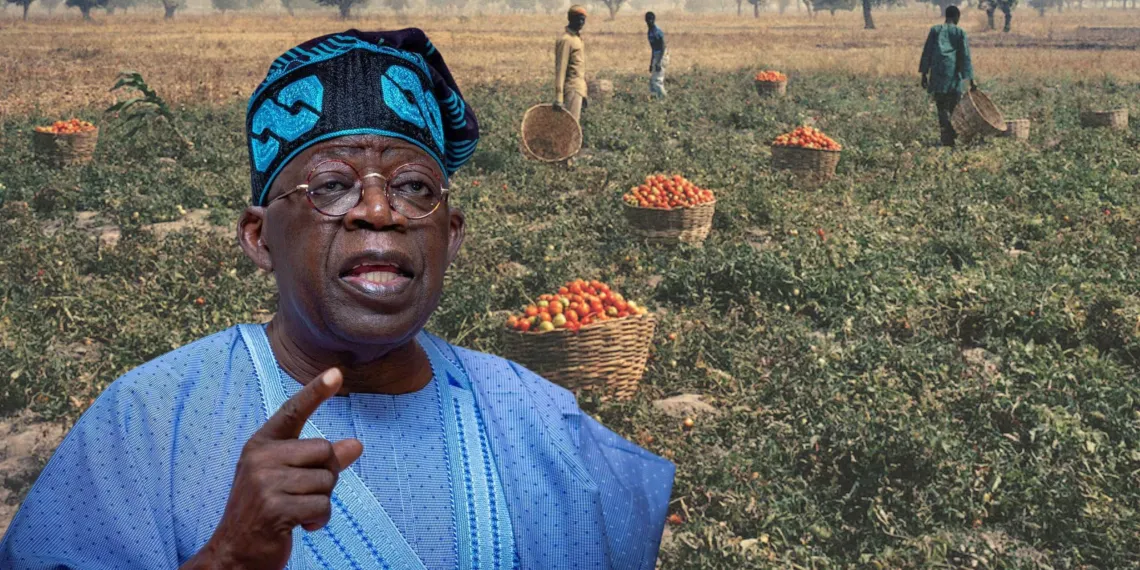
Insecurity in rural areas, particularly in food-producing states, continued to disrupt agricultural activities. Additionally, extreme weather, including heat waves, droughts, and floods, made food production increasingly challenging nationwide.
byMary IzuakaandAbdulkareem Mojeed
Reading Time: 6 mins read


When President Bola Tinubu assumed office as Nigeria’s new president in May 2023, he promised to enhance agricultural production and ensure food security. However, two years into his first term, Nigeria faces a hunger crisis more severe than when he came into office.
This crisis is primarily attributed to his decision to stop fuel and foreign exchange subsidies. These policies substantially increased the costs of transportation and agricultural inputs. The soaring prices of goods and services have occurred alongside a decline in purchasing power, hitting Nigerians with a double whammy. The high food costs have prompted multiple public protests across the country.
Insecurity in rural areas, particularly in food-producing states, continued to disrupt agricultural activities. Additionally, extreme weather, including heat waves, droughts, and floods, made food production increasingly challenging nationwide.


Recently, the government rolled out new policies and initiatives to increase food production, drive down prices, and tackle the cost-of-living crisis. However, Nigerians wonder whether the price hikes can be reversed, as their hope of relief lies there.
The government has initiated some measures to address the shortfall in food supply.
State of Emergency in Agriculture
In July 2023, President Tinubu declared a state of emergency on food insecurity, targeting the food supply shortfall and rising food prices. He unveiled a comprehensive food security, affordability, and sustainability intervention plan with short, medium and long-term goals.


“In the immediate term, we intend to deploy some savings from the fuel subsidy removal into the agricultural sector, focusing on revamping the sector,” the president said.
He directed that “all matters pertaining to food and water availability and affordability, as essential livelihood items, be included within the purview of the National Security Council.”
Increased Budgetary Allocation
The administration has steadily increased budgetary allocations to the sector, growing from N228.4 billion in 2023 (1.05 per cent of total budget) to N362.94 billion in 2024 (1.32 per cent) and N826.5 billion in 2025 (1.7 per cent).
Dry Season Farming Initiative
It introduced the Dry Season Farming Initiative on 500,000 hectares of farmland, financed by the African Development Bank with $134 million to promote year-round farming, supported with irrigation and storage facilities.
In November 2023, this newspaper reported the enthusiasm of wheat farmers in Jigawa State for dry-season farming following the state and federal governments’ commitments to the National Wheat Development Programme, which was flagged off in the state. At the ceremony, the Minister of Agriculture and Food Security, Abubakar Kyari, said the federal government would cultivate 100,000 hectares of wheat this dry season. Allocating 40,000 hectares to the programme, Jigawa governor, Umar Namadi, said it aligned with his administration’s development agenda.

![Minister of Agriculture and Food Security, Abubakar Kyari. [PHOTO CREDIT: Official X account of Mr Kyari | https://x.com/SenatorAKyari/status/1793753864455250319/photo/1]](https://i0.wp.com/media.premiumtimesng.com/wp-content/files/2024/06/Minister-of-Agriculture-Abubakar-Kyari.jpeg?resize=2048%2C1366&ssl=1)
Partnership with John Deere:
In November 2023, the Nigerian government signed a Memorandum of Understanding (MoU) with global agricultural machinery giant John Deere to deliver 2,000 tractors annually to Nigeria. Mr Kyari described the contract as a strategic partnership to establish a tractor plant in Nigeria to modernise agriculture and food production.
Partnership with Brazil
In November 2024, the Federal Ministry of Agriculture and Food Security (FMAFS) and Fundação Getulio Vargas (FGV) of Brazil signed an MOU to advance private sector development in fertiliser production, hybrid seed technology, and agricultural finance. FGV is the lead implementer of the Green Imperative Project (GIP), one of the largest international agricultural technology transfer initiatives. Conceived in 2018, GIP is a $1.2 billion cooperative effort between Brazil and Nigeria, designed to modernise Nigeria’s agricultural sector through Brazilian expertise in tropical agriculture.
According to the government, over the next five years, the project will identify and support one agribusiness in Nigeria’s 774 local government areas with technical and financial resources, driving sustainable development and economic growth.
Qatari Investment:
In May 2025, Mr Tinubu welcomed Qatari investment plans in Nigeria’s agriculture sector and reaffirmed his country’s openness to deeper strategic partnerships. While hosting Qatar’s Minister of State for Foreign Affairs at the time, Mohammed bin Abdulaziz Al-Khulaifi, Mr Tinubu emphasised food security and economic growth as key areas for partnership.
Contribution to GDP
GDP Growth: The agricultural sector contributed 25.59 per cent to GDP and grew by 1.76 per cent in Q4 2024, indicating emerging potential. In April, the Minister of Budget and Economic Planning, Abubakar Bagudu, attributed the growth to the focused policy direction and strategic interventions initiated under Mr Tinubu’s administration.
He said a N100 billion National Agricultural Development Fund set up in 2023 to address financing bottlenecks, and the Central Bank of Nigeria’s donation of 2.15 million bags of fertiliser, valued at another N100 billion, to support farmers had also contributed to the sector’s gains.
Food Security
In July 2023, Mr Tinubu said his administration would disburse N200 billion from the N500,000 billion approved by the National Assembly to cultivate major staple crops in the country to address food inflation.
From the amount, he said N50 billion would be invested to cultivate 150,000 hectares of rice and maize, and N50 billion each for 100,000 hectares of wheat and cassava. Mr Tinubu said the government was engaging with various farmers’ associations and operators within the agricultural value chain.
“To this end, I have ordered the release of 200,000 Metric Tonnes of grains from strategic reserves to households across the 36 states and FCT to moderate prices. We are also providing 225,000 metric tonnes of fertiliser, seedlings and other inputs to farmers, who are committed to our food security agenda,” he noted.
In February 2024, the Federal Ministry of Agriculture and Food Security said it was about to release 42,000 metric tonnes of assorted food commodities to support the country’s vulnerable population.
In September 2024, Mr Kyari flagged off the sale of rice at a flat rate of N40,000 per 50kg bag. The minister said the subsidised rice initiative was one of the measures the administration took to cushion the impact of rising food costs, which had been exacerbated by factors such as COVID-19, the Russia-Ukraine war, and climate change.
In April, the African Development Bank (AfDB), in collaboration with the Nigerian government, inaugurated the Special Agro-Industrial Processing Zones (SAPZ) Project in Kaduna. The initiative was part of a broader strategy to address food insecurity and enhance agricultural practices in Nigeria.
Food inflation
The inflation rate has steadily risen despite the administration’s initiatives to control food inflation and enhance food security. According to the National Bureau of Statistics (NBS), food inflation rose to 39.84 per cent in December 2024 from 33.93 per cent December 2023.
However, a recent rebasing of the consumer price index (CPI) led to a significant drop in inflation rates from 34.80 per cent in December 2024 to 24.48 per cent in January 2025, with food inflation decreasing to 23.51 per cent in February 2025.
Challenges
Speaking with PREMIUM TIMES, Ibrahim Kabir, the national president of All Farmers Association of Nigeria (AFAN), highlighted the progress and challenges facing the agriculture sector in the past two years.
He highlighted the challenges of insecurity, climate change, and poor implementation of government policies. He said more needs to be done to address the pressing issues, despite recent initiatives to support farmers. Mr Kabir said that while farmers are starting to get better value for their produce, consumers are struggling with high food prices due to inflation.
“What I will give you is two prongs. There are successes and failures. And they are not necessarily dependent on who the president is. Insecurity is a significant threat to productivity in agriculture. And then there is also the effect of climate change. On the other issues of seed, some mechanisation and policies, we have problems regarding implementation,” Mr Kabir said.
He said the president has brought out many windows of support for farmers, “And they are a work in progress.”
“As farmers, we are having problems in terms of pricing. Recently, prices have come down. But you, the consumers, still think that they should come down more. So we are caught between the devil and the deep blue sea. Farmers are just getting value for what they produce. However, as consumers, our low purchasing power means we cannot afford food. Therefore, we complain that there is inflation.”