



Bahrain has secured international recognition for its work to reduce ozone-depleting substances after the executive committee of the Multilateral Fund for the Implementation of the Montreal Protocol approved the third and final phase of the kingdom’s Hydrochlorofluorocarbon Phase-out Management Plan. The approval, granted during the committee’s 98th meeting, reflects Bahrain’s progress in building a comprehensive system to control refrigerants and reduce the use of environmentally harmful chemicals. Led by the Supreme Council for Environment, the programme forms a key part of the country’s commitments under the Montreal Protocol and positions Bahrain as a regional example in managing the transition away from HCFCs.
Targets Exceeded
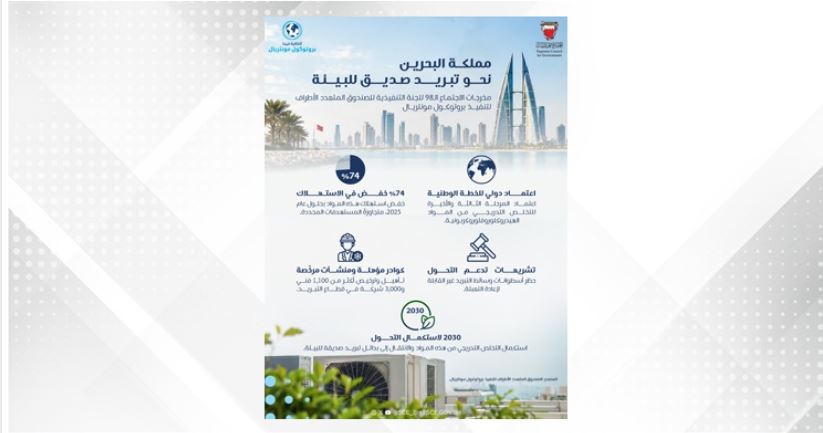
A report on Bahrain’s experience noted that the kingdom has surpassed the targets set in the first two stages of its plan. HCFC consumption has been reduced by 74 per cent against the 2025 baseline, demonstrating the impact of tighter regulation and stronger monitoring.
The fund said Bahrain’s approach offers useful lessons for other countries working to phase out harmful refrigerants while maintaining effective oversight of the cooling sector.
Stronger Controls
The national framework includes licensing requirements for refrigeration and air-conditioning technicians and companies, restrictions on releasing refrigerants directly into the atmosphere, and mandatory recovery, recycling and reclamation. Large cooling systems are also subject to leak monitoring.
Bahrain has also become the first country in the region to prohibit non-refillable refrigerant cylinders. A National Refrigerant Reclamation Centre has been established, supported by a recovery and recycling network and an electronic system for regulating refrigerant imports and exports.
Training and Licensing
The qualification programme now covers about 1,100 licensed technicians and 3,000 licensed companies and workshops. Authorities use an integrated database to verify licences, support inspections and track operators across the sector.
Additional measures include bans on importing or manufacturing air-conditioning equipment using HCFC-22 and on HCFC-141b in pre-blended polyol mixtures, effective from January 1, 2025.
Final Phase Ahead
The final stage will focus on stronger regulatory oversight, improved digital monitoring and reporting, and greater traceability through licensing systems. It will also support Bahrain’s planned ban on HCFC imports by 2030 and future work under the Kigali Amendment Implementation Plan.