





Bahrain Poultry Meat Market Analysis
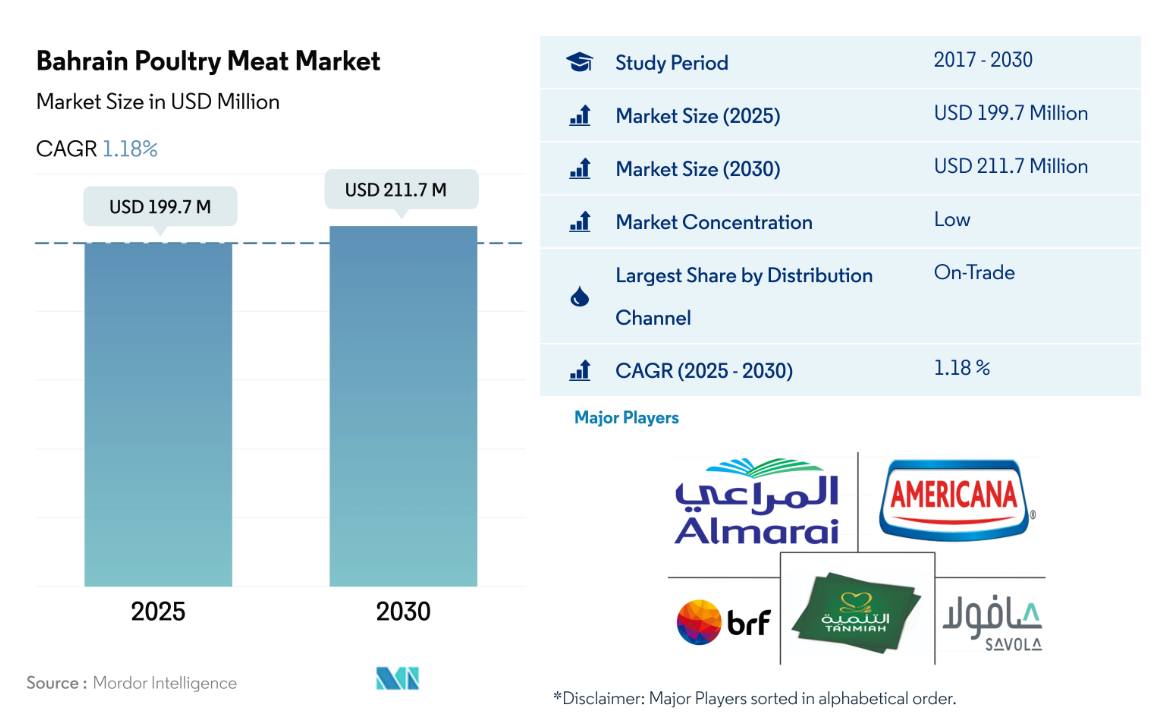
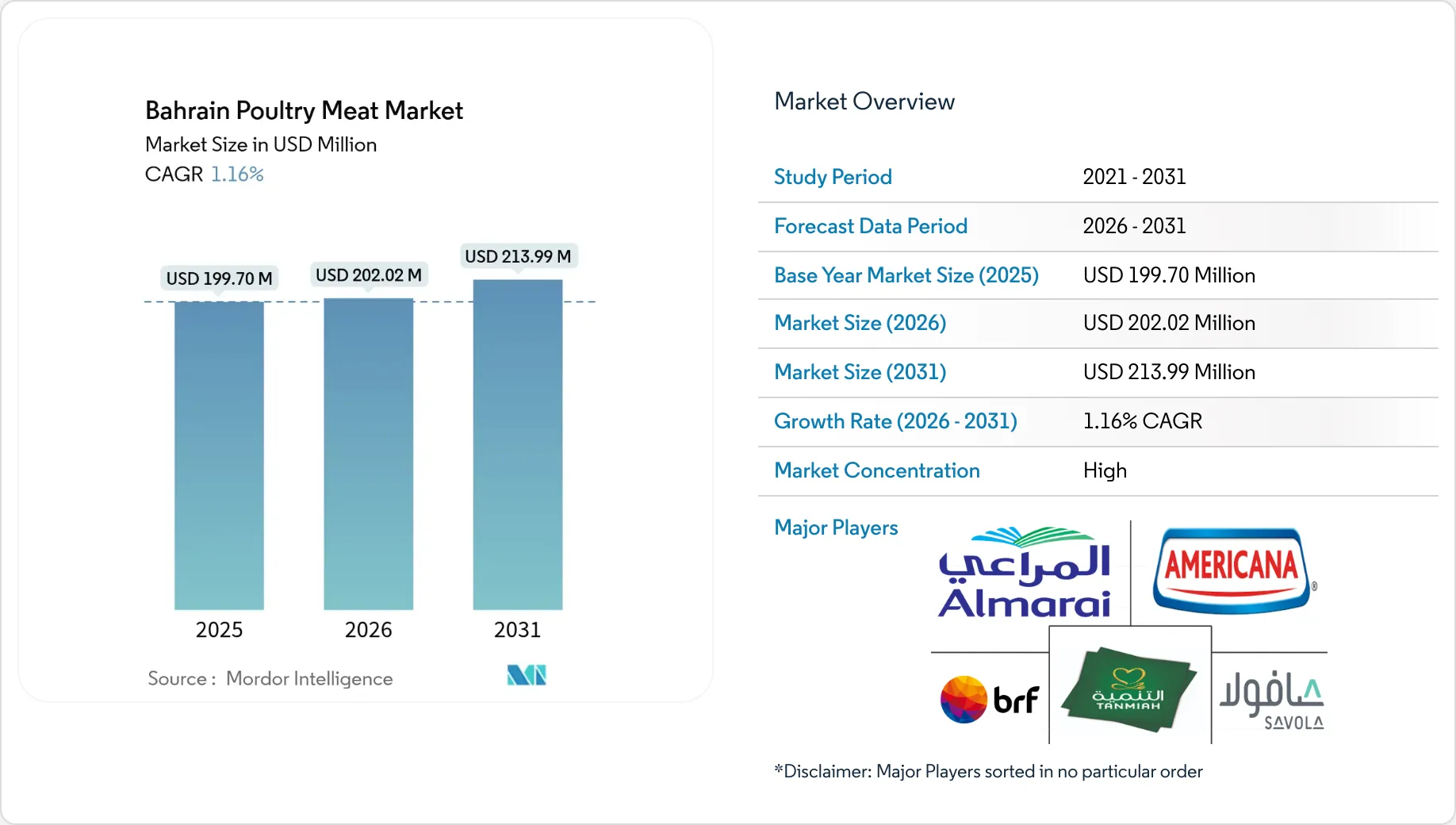
The Bahrain Poultry Meat Market size is estimated at 199.7 million USD in 2025, and is expected to reach 211.7 million USD by 2030, growing at a CAGR of 1.18% during the forecast period (2025-2030).
The Bahraini poultry meat industry is experiencing significant digital transformation, driven by technological advancements and changing consumer preferences. The country’s remarkable internet penetration rate of 99% in 2021, serving over 1.71 million users, has revolutionized the way consumers purchase poultry products. Modern retailers are implementing innovative technologies such as self-checkout services and contactless payment systems, enhancing the shopping experience. This digital evolution is particularly evident in the expansion of online delivery platforms and e-commerce channels, with major retailers like Carrefour and Lulu Group investing heavily in their digital infrastructure and delivery capabilities.
The foodservice sector has emerged as a crucial growth driver for the poultry meat industry, supported by Bahrain’s booming tourism sector. A remarkable 984% increase in tourist arrivals has been recorded in recent periods, stimulating demand for chicken meat-based dishes across restaurants and hotels. The country’s foodservice landscape is diversifying, with international chains expanding their presence and local establishments innovating their menus to cater to evolving consumer preferences. This trend is particularly notable in the increasing popularity of quick-service restaurants and casual dining establishments that prominently feature white meat dishes.
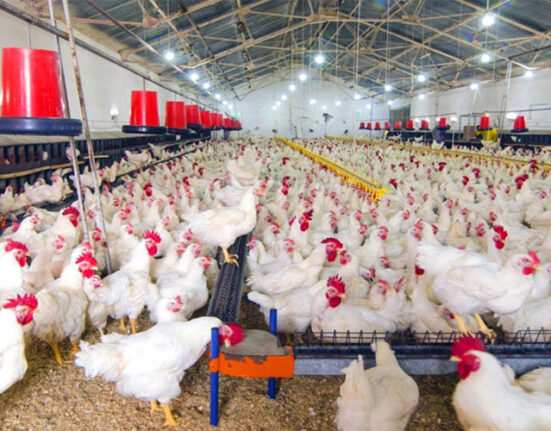
Bahrain’s domestic poultry meat production infrastructure is undergoing significant modernization to enhance self-sufficiency and ensure a stable supply. The country produced approximately 8.3 thousand tons of chicken meat in 2022, making it the second-highest domestically produced meat category. The government’s initiative to distribute licenses for chicken slaughterhouses has encouraged traders to engage in local production, with plans to increase local commercial poultry production from 9 million to 20 million chickens between 2023 and 2025. This focus on domestic production has helped maintain competitive pricing, with fresh poultry meat available at USD 2.5 per kilogram, approximately 30-40% lower than red meat prices.
The retail landscape for poultry products continues to evolve, shaped by Bahrain’s unique demographic composition and urbanization trends. With an urban population of 1.69 million in 2022, representing 89.5% of the total population, the market has witnessed significant retail expansion, now hosting 335 supermarkets as of August 2023. The increasing female workforce, which grew by 2.7% from 2020 to 2022, has influenced product development and retail strategies, particularly in the convenience and processed poultry segments. Retailers are responding by offering diverse product ranges, from fresh and frozen options to value-added processed products, catering to the time-constrained urban consumer base.
Bahrain Poultry Meat Market Trends
Increased domestic poultry production driving the market growth
- Due to its limited ability to cultivate crops, Bahrain relies heavily on food imports to meet local food demand, importing about 94% of its food in 2022. Bahrain is currently in the 55th position in the Global Food Security Index and lags behind major Gulf countries like Qatar, UAE, Saudi Arabia, and Kuwait. The total volume of food imports increased by 7.8% from 2015 to 2021 in Bahrain, a greater increase than bigger GCC countries such as Saudi Arabia (5.3%) and UAE (3.1%).
- In February 2021, Bahrain and UAE signed a Memorandum of Understanding (MoU) to exchange expertise, studies, and research related to food security. This partnership involved conducting joint training programs as well as significant investments, loans, and subsidies from the government’s end to farmers, encouraging the private sector and eventually boosting local production.
- Bahrain is very open to foreign direct investments, and as of 2021, FDI in Bahrain increased by 73% to USD 1.76 billion. Foreign investments and partnerships also benefit the current production scenario. The Bahraini Ambassador of Brazil and Minister of Works, Municipal Affairs, and Urban Plannings conducted an investor’s forum in 2021 to welcome foreign investments in the livestock sector. The forum also explored the advantages of modern technologies to support the livestock sector in the field of breeding, as well as to increase the import and export of livestock, red and white meat, and veterinary medicine between the two countries. An agreement regarding food security was signed between Bahrain and Israel in 2020. As of 2021, Bahrain produced around 9 million chicks and imported about 70,000 metric tons of poultry, an 18,000 metric ton increase over 2019, where the import was 52,000 metric tons.

Understand The Key Trends Shaping This Market
Download PDF
Rising production costs are impacting poultry prices
- The poultry meat market registered a CAGR of 2.08% from 2017 to 2022 in Bahrain. The country has been recently working on food security and self-reliance, owing to which the government is distributing licenses for chicken slaughterhouses to influence the traders to indulge in local production. Bahrain plans to increase local poultry production from 9 million to 20 million chickens over the period of 2023 to 2025 to satisfy the exponentially increasing consumption in the country. Also, an increase in local production will help in moderating the price level in the country, as reliance on imported commodities would be lower.
- The recent surge in prices of poultry meat in all forms and varieties is occurring in Bahrain. This is mostly because of the increase in the prices of local chicken, owing to its high feed and logistics costs. Some persistent logistical problems suppliers have been facing constantly are driver shortages, port congestion, soaring freight rates, and more. Also, with oil prices falling, Bahrain, primarily depending on oil and gas export revenue, lifted price subsidies on various goods and services, including meat, which helped the government recover USD 75 million in 2021.
- The price of poultry meat is also severely affected by chicken feed prices. Prices of soybean and maize, the two key inputs that are used as livestock feed in the poultry industry, are rising sharply due to the conflict between Russia and Ukraine. The main driver of rising feed costs has been soybean. Feed accounts for 70% of variable costs, and by volume, maize forms 60-63% of the feed, while soymeal forms 25-27%. In 2021, maize prices fell by 30%, while soybean prices rose by 6% Y-o-Y compared to the previous year.

Segment Analysis: Form
Fresh/Chilled Segment in Bahrain Poultry Meat Market
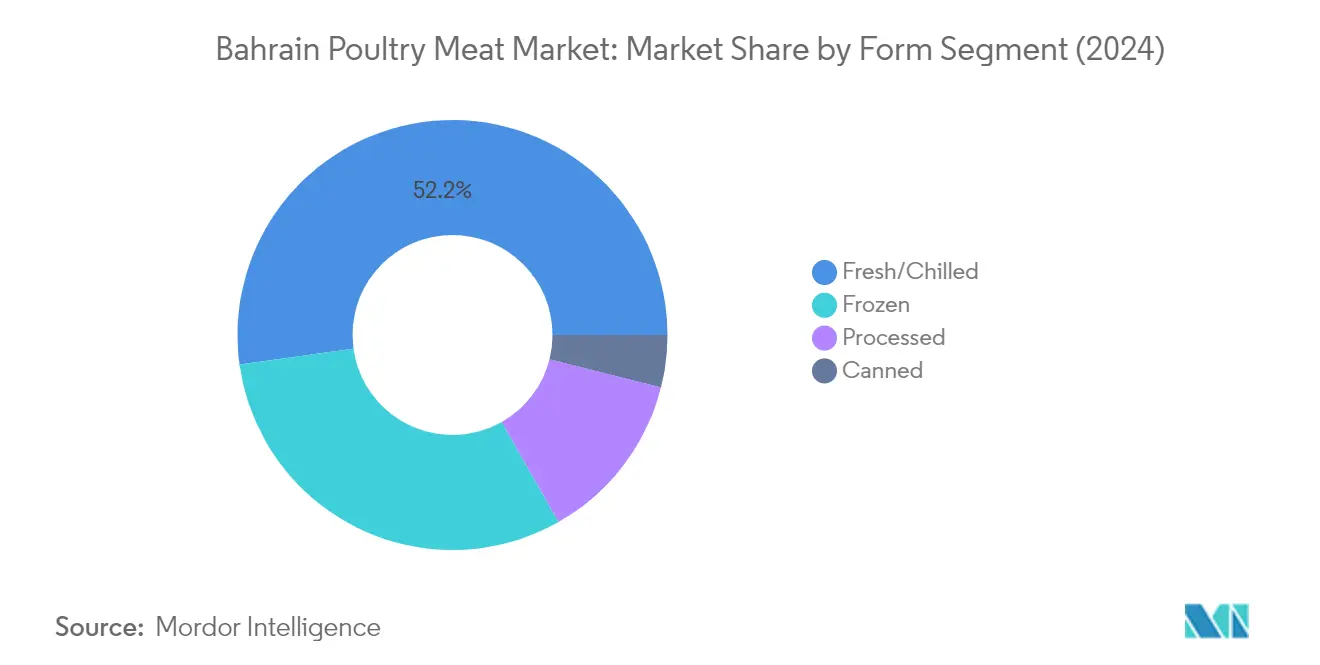
The fresh poultry segment dominates the Bahrain poultry meat market, commanding approximately 52% market share by value in 2024. This significant market position is driven by consumer preferences for fresh poultry products due to their perceived higher nutritional value and superior flavor profile. The segment’s dominance is further strengthened by the expanding network of modern retail outlets and cold chain infrastructure across Bahrain. Households predominantly prefer raw poultry over other forms due to minimal preparation time requirements. The segment’s growth is supported by major poultry farms expanding their production capacities to achieve self-sufficiency in domestic supply. The average price point of fresh poultry meat, being around half that of beef and other meats, continues to drive sales through affordability.
Processed Segment in Bahrain Poultry Meat Market
The processed poultry segment is emerging as the fastest-growing category in the Bahrain poultry meat market for the period 2024-2029. This growth is primarily driven by increasing urbanization and the rising demand for convenient, ready-to-cook processed poultry products. The segment’s expansion is supported by innovations in product offerings, including new variants of nuggets, sausages, and marinated products that cater to evolving consumer preferences. International fast-food chains and local food service establishments are significantly contributing to the segment’s growth by introducing various processed poultry products. The segment is witnessing substantial investments in research and development, leading to the introduction of healthier processed options with reduced sodium content and natural ingredients.
Remaining Segments in Form
The frozen poultry and canned segments complete the Bahrain poultry meat market’s form segmentation, each serving distinct consumer needs and preferences. The frozen poultry segment maintains a strong presence in the market due to its longer shelf life and convenience in storage, particularly appealing to bulk buyers and food service establishments. Meanwhile, the canned segment, though smaller in market share, serves specific market needs such as military supplies and emergency food storage. Both segments benefit from ongoing improvements in preservation technologies and packaging innovations, while also adapting to increasing consumer demand for high-quality, convenient poultry products.
Segment Analysis: Distribution Channel
On-Trade Segment in Bahrain Poultry Meat Market
The on-trade segment holds a significant position in Bahrain’s poultry meat market, accounting for approximately 50% of the total market value in 2024. This substantial market share is primarily driven by the robust foodservice sector, where over 45% of outlets incorporate chicken dishes in their menus. The segment’s strength is further reinforced by the country’s thriving tourism sector and the proliferation of international restaurant chains. Fresh/chilled poultry meat dominates the on-trade channel, particularly due to its extensive use in popular dishes like biryani, shawarma, kebabs, and grilled preparations. The segment’s growth is supported by the expansion of both local and international restaurant chains, including major players like McDonald’s, KFC, and various regional establishments that primarily serve chicken-based dishes.
Online Channel Segment in Bahrain Poultry Meat Market
The online distribution channel is experiencing remarkable growth in Bahrain’s poultry meat market, projected to expand at approximately 11% CAGR from 2024 to 2029. This exceptional growth is primarily fueled by the country’s high internet penetration rate, which stands at 99% of the total population. Major platforms like Carrefour, Lulu Hypermarket, Talabat, Instashop, and Nanadirect are actively expanding their digital presence and improving their delivery infrastructure to meet the growing demand. The segment’s growth is further supported by the increasing adoption of digital payment solutions and enhanced cold chain logistics capabilities. Online platforms are particularly successful in offering a diverse range of poultry products, from fresh and chilled to frozen poultry varieties, catering to the evolving preferences of tech-savvy consumers in Bahrain.
Bahrain Poultry Meat Industry Overview
Top Companies in Bahrain Poultry Meat Market
The Bahrain poultry meat market features a mix of global and regional players competing through various strategic initiatives. Companies are increasingly focusing on product innovation, particularly in developing new flavors, convenient packaging formats, and value-added processed poultry products to meet evolving consumer preferences. Operational agility has become crucial, with companies investing in advanced cold chain infrastructure and distribution networks to ensure product freshness and availability. Strategic partnerships with local distributors and foodservice operators have emerged as a key trend to enhance market presence. Companies are also expanding their production capacities through new facility establishments and acquisitions, while simultaneously investing in technology upgrades to improve operational efficiency and maintain quality standards. The emphasis on halal certification and food safety compliance remains paramount across all strategic initiatives.
Market Dominated by Regional Food Conglomerates
The Bahrain poultry products market exhibits a moderately consolidated structure, with regional food conglomerates holding significant market positions alongside global players. These established companies leverage their extensive distribution networks, brand recognition, and diverse product portfolios to maintain their market positions. The market is characterized by the strong presence of Saudi Arabian and UAE-based companies that have successfully expanded their operations into Bahrain through strategic investments and partnerships. These regional players benefit from their understanding of local taste preferences, established relationships with retailers, and proximity to the market.
The competitive landscape is evolving with increasing merger and acquisition activities, particularly involving regional players seeking to strengthen their market presence. Large food conglomerates are acquiring local processing facilities and distribution networks to enhance their vertical integration capabilities. The market also witnesses strategic collaborations between international and local players, combining global expertise with local market knowledge. Companies are increasingly focusing on backward integration to ensure supply chain control and maintain quality standards, while also investing in modern processing facilities to meet growing demand.
Innovation and Distribution Key to Growth
Success in the Bahrain industrial poultry market increasingly depends on companies’ ability to innovate across their product portfolio while maintaining efficient distribution networks. Market leaders are focusing on developing premium product lines, implementing sustainable practices, and expanding their processed meat offerings to capture higher margins. Companies are also investing in digital platforms and e-commerce capabilities to reach more consumers and enhance their market presence. The ability to maintain consistent quality while offering competitive pricing remains crucial, particularly given the price-sensitive nature of the market and the presence of various substitutes.
Future success in the market will require companies to adapt to changing consumer preferences while maintaining operational efficiency. Contenders can gain ground by focusing on niche segments, such as organic and premium products, while also developing strong relationships with key foodservice operators. Companies must also prepare for potential regulatory changes, particularly regarding food safety standards and environmental regulations. The increasing focus on food security in Bahrain presents opportunities for companies that can demonstrate reliable supply capabilities and maintain strong relationships with local authorities. Building strong brand equity through quality consistency and innovative marketing approaches will be essential for both incumbents and new entrants.
Bahrain Poultry Meat Market Leaders
- Almarai Food Company
- Americana Group
- BRF S.A.
- Tanmiah Food Company
- The Savola Group
- *Disclaimer: Major Players sorted in no particular order

Need More Details on Market Players and Competitors?
Download PDF
Bahrain Poultry Meat Market News
- July 2022: BRF Sadia inaugurated its new Al Joody plant in Saudi Arabia after acquiring it in 2021. The new plant helps in increasing the production capacity to 1200 metric ton per month.
- July 2022: Tanmiah Food Company and Tyson Foods signed a strategic partnership to expand poultry production capacity. This investment is aligned with Tanmiah’s strategic expansion agenda and is expected to result in doubling the company’s production capacity in value-added products.
- December 2021: LuLu Group launched its latest product categories, including the poultry meat range, in collaboration with world-class brands and leading manufacturers.
Free With This Report
We offer a comprehensive and exhaustive set of data pointers. These cover global, regional, and country-level metrics that illustrate the fundamentals of the meat and meat substitutes industry. Clients can access in-depth market analysis through 45+ free charts. This analysis is based on the production of various meat and seafood types, as well as the prices of meat, meat substitutes, and different seafood types. We provide granular-level segmental information, supported by a repository of market data, trends, and expert analysis. Data and analysis on meat types, seafood types, meat substitute types, forms, distribution channels, and more are available. These are provided in the form of comprehensive reports as well as Excel-based data worksheets.


Source: https://www.mordorintelligence.com/industry-reports/bahrain-poultry-meat-market
Leave feedback about this